Your Equipment Is the Heart of the Operation
A heritage railroad's locomotives and coaches are not just business assets — they are often one-of-a-kind machines, decades or even a century old, restored by hand over thousands of volunteer and shop hours. A standard commercial property policy has no idea what a 2-8-0 steam locomotive or a wooden heavyweight Pullman coach is worth, and it will not pay anything close to what one is actually worth if it's damaged or destroyed. That mismatch is why dedicated rolling stock coverage exists.
At Locomotive Insurance, a division of Contractors Choice Agency, rolling stock and restoration coverage is one of the most carefully tailored parts of every program we write. This article explains how the coverage works, why agreed value is so important, and what restoration shops in particular need to protect.
What Counts as Rolling Stock
Rolling stock coverage applies to the equipment that runs on your rails, including:
- Locomotives — steam, diesel-electric, and electric motive power.
- Passenger equipment — coaches, combines, observation cars, dining cars, and cabooses.
- Freight equipment — boxcars, gondolas, flatcars, and tank cars on short-line operations.
- Maintenance-of-way equipment — speeders, ballast cars, cranes, and work equipment.
- Static display and stored equipment — pieces not currently operating but still valuable and exposed to loss.
Each of these has a different value, condition, and use, and a well-built schedule lists them individually so coverage and limits match reality.
The Perils Rolling Stock Faces
Rolling stock is exposed to risks that ordinary property forms barely contemplate:
- Fire — a constant concern around steam locomotives, fuel, and historic wooden equipment.
- Collision and derailment — both on your own line and during interchange or movement.
- Vandalism and theft — including theft of brass, bronze, and valuable components from stored equipment.
- Weather and storage perils — wind, flood, and damage to equipment stored outdoors or in aging structures.
- Transit damage — when equipment is moved by truck or over another railroad to reach your line.
A rolling stock policy is designed around these specific exposures rather than the generic perils on a building policy.
Why Agreed Value Is Essential
The single most important concept in insuring historic equipment is agreed value. Standard property coverage typically pays actual cash value — replacement cost minus depreciation — which is meaningless for a hand-restored locomotive. Depreciation logic would value a beautifully restored 1920s locomotive at almost nothing, even though replacing or rebuilding it would cost a fortune in skilled labor and fabricated parts.
Under an agreed-value approach, you and the insurer settle on a figure in advance — supported by restoration records, appraisals, and documentation of the labor invested — and that's the number paid on a covered total loss. For irreplaceable equipment, agreed value is the difference between a claim that rebuilds your operation and one that doesn't come close. Good documentation up front makes this process smoother, so keep your restoration logs, photos, and appraisals current.
Restoration Shops and Work in Progress
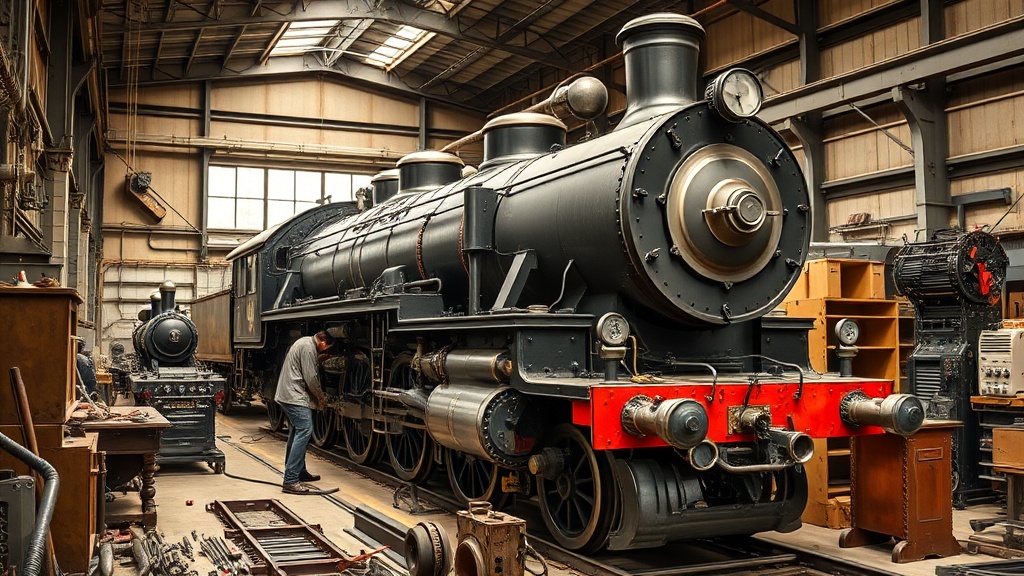
Restoration shops carry a distinct set of exposures beyond the finished equipment. A locomotive stripped down to its chassis, a boiler out for inspection, or a coach mid-rebuild represents enormous accumulated value that a finished-equipment schedule may not capture. A restoration-focused program should address:
- Work in progress — the rising value of a project as labor and parts accumulate, so a fire mid-restoration doesn't leave you paying out of pocket.
- Parts and materials — castings, fabricated components, hard-to-source vintage parts, and raw stock.
- Tools and shop equipment — lathes, presses, welding equipment, and specialized railroad tooling.
- Property of others — if you restore equipment owned by another railroad, museum, or private owner, you have bailee exposure for property in your care, custody, and control.
- Shop premises and liability — the building itself plus general liability for the shop environment.
Restoration shops also generate pollution exposure — solvents, oils, fuel, lead paint, and asbestos abatement on older equipment can all create environmental and cleanup obligations that standard policies exclude. Dedicated pollution liability is worth discussing for any shop doing heavy restoration.
Equipment in Transit and Interchange
Moving a locomotive or coach — whether on its own wheels over a host railroad, on a heavy-haul trailer, or by crane — is one of the highest-risk moments in an equipment's life. Coverage should clearly extend to transit and loading/unloading, and you should confirm how a loss is handled if the equipment is damaged on another railroad's track. If you operate over host trackage, the host will also typically require certificates and additional-insured status, and your rolling stock and liability coverage need to align with those agreements.
Property: Roundhouses, Shops, and Depots
The structures that house your equipment matter too. Roundhouses, engine houses, shop buildings, and depots are often historic, hard to replace, and full of valuable contents. Commercial property coverage for these buildings should reflect their construction and replacement realities, and business-interruption coverage deserves a look — losing your shop can halt restoration and operations alike.
Document, Schedule, and Insure It Properly
The operators who fare best after a loss are the ones who scheduled every piece, documented its value, and built coverage on an agreed-value basis before anything happened. Your equipment is too important — and too irreplaceable — to insure on a generic property form. To make sure your locomotives, coaches, and in-progress restorations are protected for what they're truly worth, contact a Locomotive Insurance agent for a tailored rolling stock review and quote.